(Time to read this Blog is about 4 minutes)
Before we get to the main topic, here are a few things to get you thinking or smiling:
- My Biz Quote of the week:
“Companies often say that their employees are their most important asset. But many of those same companies treat their employees as if they’re ‘disposable’. If you treat them as if they’re disposable, they’ll behave as if they’re disposable.”
…Donald Cooper.
- Quick Biz Tip:
Are you innovating…or falling behind?
A UK startup, Tera Mira, has developed an alternative to conventional stretchy fabrics like Lycra and Spandex, both of which are produced from petrochemicals.
Tera Mira’s new bio-based stretchy fabric, made from seaweed, is designed for both performance and environmental circularity. It is compostable and compatible with existing manufacturing processes.
Whatever you sell, what are you doing to innovate and create the next great product, service or customer experience, to improve performance, to create world-class operational efficiency, or to be more environmentally responsible?
If you don’t ‘create the next’, somebody else will…and you’ll spend the rest of your life complaining about ‘unfair competition’. What innovation and courage will it take for you to be the ‘unfair competition’ in your market?
- If you love irony: On June 24, a Conference on ‘The Economic Impacts of Climate Change’, scheduled to held at the London School of Economics in the UK, was cancelled at the last minute when the British Government issued a ‘Red Heat Warning’ about record temperatures that were high enough to pose serious health risks.
- How long does it take for the grass tennis courts at Wimbledon to recover after the iconic 2-week Tournament? If you watched the grand spectacle that is the Wimbledon Tennis Tournament, you probably wondered, like me, how long it takes for the beaten-up grass to recover. Here’s the answer:
Wimbledon does not actually wait for the grass to recover. The day after the final, the Grounds Crew starts stripping the worn turf and top layer of soil from all 18 tournament courts, replaces it with 6 tons of new soil, per court, and then re-seeds all the courts with a total of 10 tons (20,000 pounds) of perennial ryegrass. It takes 50 weeks of care and grooming to make the tournament courts ready for the following year’s Wimbledon Classic.
So, what disciplined process and unwavering commitment does your business follow to make sure that you’re in perfect condition and perform as promised on ‘Game Day’? And, in business, every day is ‘Game Day’!
- Fake online reviews, designed to dupe consumers are big business. They’re written, for a fee, by small independent fraudsters and big ‘Review Farms’ that crank out thousands of fake reviews every day. In 2025, Google found and removed 295 million fake reviews.
Now, to this week’s important topic:
What is the ‘Revolving Door Tax’ in your business?
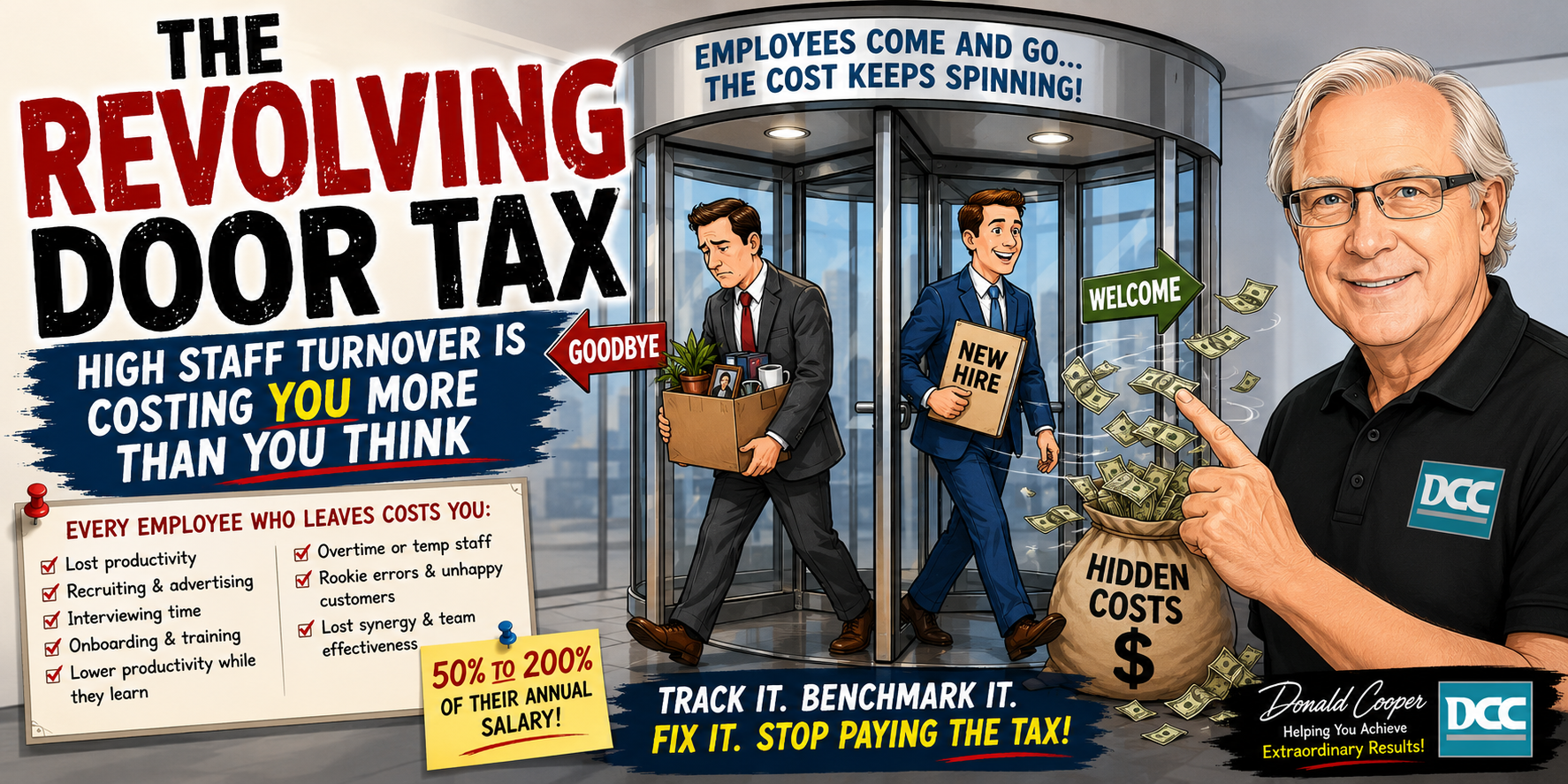
High staff turnover will cost you big time. I call this ‘The Revolving Door Tax’.
A widely cited ‘rule of thumb’ is that replacing an employee costs about 50% to 200% of their annual salary. The actual amount varies by role and organization. For highly skilled or leadership positions, the cost can exceed 200% of annual salary due to longer hiring times, specialized training and lost productivity.
These costs typically include:
- Lost productivity from the departing employee,
- Recruiting and advertising expense or a Fee to a Recruitment Agency (typically 15% to 25% of the 1st-year salary),
- Interviewing time,
- Onboarding and training,
- Lower productivity while the new hire learns the job,
- Potential overtime or temporary staffing to fill the gap.
- The cost of ‘rookie errors’ and, on the ‘front lines, the cost of an untrained new employee ‘ticking off’ or frustrating customers.
- The cost of lost synergy and effectiveness while the new person settles into a Team or Department.
How does your staff turnover compare to well-managed businesses in your industry, or your area? Do you even track this? Benchmarking provides useful information about how you’re doing.
There are two main reasons for staff turnover:
- You’re hiring the wrong people (incompetent, lazy, toxic or dishonest), they don’t work out and you have to fire them…sometimes at great expense and often with great disruption to the business.
Do you have up-to-date, outcomes-based Job Descriptions so you know who you’re looking for? Do you have an effective interviewing, screening and testing process, complete with background and reference checks? Do you like to hire troubled people, and then ‘rescue’ them?
- They quit because of some of the 10 reasons listed below.
- Ineffective onboarding, initial training and ongoing training,
- Uncompetitive pay and / or benefits,
- Incompetent or toxic Managers or Supervisors who drive good people away,
- Hours and conditions of work,
- Lack of recognition and appreciation,
- An emotionally unhealthy, toxic culture in some parts of the business,
- They can’t do the job, they should never have been hired and they quit in frustration,
- They’re excellent employees but they don’t see a great future with you, so they go looking for a better opportunity…or a competitor lures them away.
- Lack of the latest technology that drives tech-savvy people away in frustration,
- Lack of career opportunities.
So, is high staff turnover costing you a big ‘Revolving Door Tax’? If so, how will you use these insights above to fix what needs fixing…and when will you start?
That’s it for this week…
Live brilliantly and be kind to each other!
Donald Cooper
Donald Cooper speaks and coaches internationally on management, marketing, and profitability. He can be reached by email at donald@donaldcooper.com in Toronto, Canada.